Review · SPAIN
Valencia: Art & Architecture Guided Tour with Monuments Tickets
San Nicolás Church is the star here. Its restored ceiling is covered with nearly 2,000 square meters of frescoes, earning it the nickname Valencian Sistine Chapel. I like that this tour takes you inside major monuments rather than leaving you to admire their doors from the street, and I like the mix of Gothic, Baroque, Roman, and modern Valencian stories.
The three-hour route is a good way to get your bearings in the old center. Guides such as Benito, Monika, Paulino, and Uriel have been praised for clear storytelling and useful food tips. The main caution is that this is billed as an art and architecture tour, but the experience leans just as heavily toward general history and sightseeing.
Key points to know before booking
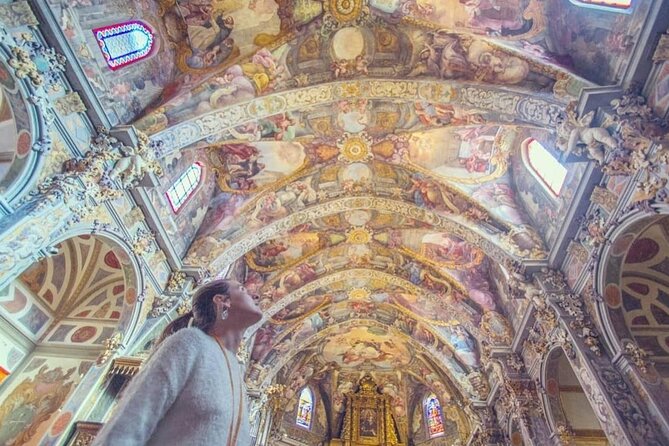
- San Nicolás is the visual highlight: Restored frescoes fill the ceiling, with a light show sometimes adding music and color to the visit.
- Three major admission tickets are included: Your price covers San Nicolás Church, La Lonja de la Seda, and Valencia Cathedral.
- The route covers about 2 to 3 miles: The pace is generally comfortable, but this is a real walking tour through the old center.
- Expect a small-group setting: The maximum group size is 20, and some departures may be much smaller.
- The tour mixes architecture with stories: You will hear about the Holy Chalice, silk trading, Roman foundations, medieval walls, and Valencian traditions.
- The meeting information deserves attention: The listed meeting point is Plaça de la Verge, while the first sightseeing stop is Torres dels Serrans, so check the final instructions carefully.
Why San Nicolás gives this walk its spark
Valencia can feel like several cities layered together. Roman foundations sit under Christian churches. A mosque once occupied the site of the Cathedral. Gothic walls carry later Baroque decoration. This walk gives you a useful framework for reading those layers instead of simply collecting photographs.
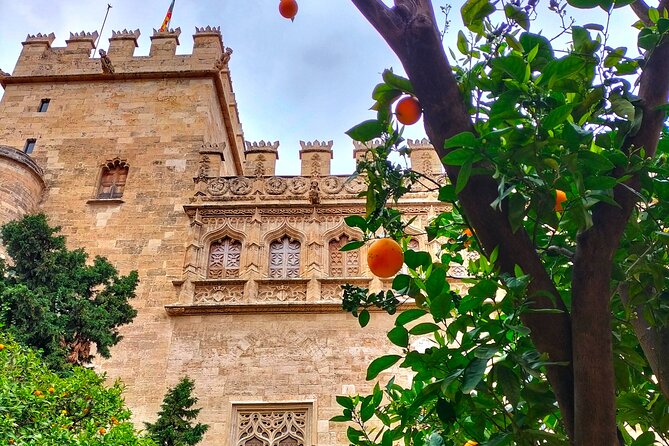
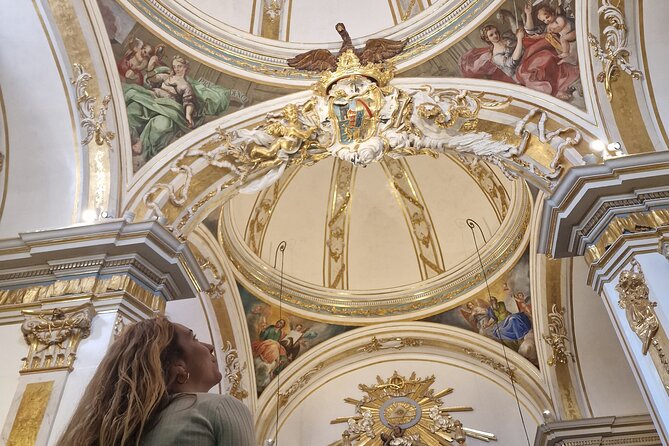
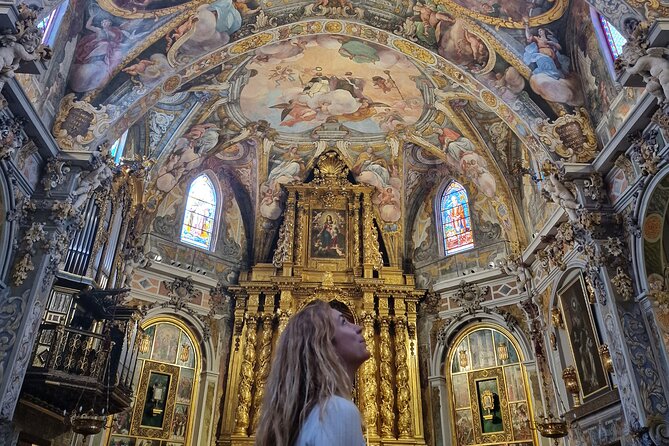
The strongest moment comes inside the Parroquia de San Nicolás de Bari y San Pedro Mártir. The church is more than 700 years old, and its Gothic structure supports an enormous Baroque ceiling filled with restored frescoes. The painted surface is described as nearly 2,000 square meters, roughly twice the fresco area of the Sistine Chapel in Rome.
I would not treat that comparison as a reason to expect a copy of Rome’s famous chapel. San Nicolás has its own character, with a long, decorated ceiling and a striking contrast between the restrained Gothic structure and the later ornamental painting. You get time inside the church, and some departures include a light presentation set to music. That visual effect has been a high point for many people on the tour.
The church also helps explain Valencia’s changing religious history. The site was used for worship in Roman times, later became a mosque, and then a Christian church. That sequence gives the guide plenty to discuss, and it makes the building more interesting than its decoration alone.
More entry tickets in Spain:
- Barcelona: Sagrada Familia Entry Ticket with Audio Guide
★ 4.6 · 105,312 reviews - Barcelona: Sagrada Familia Skip-the-Line Entry Ticket & Tour
★ 4.8 · 12,789 reviews - Park Guell and Sagrada Familia Tour with Skip the Line Tickets
★ 5.0 · 6,384 reviews
Starting near the medieval city gates
The route begins with Torres dels Serrans, one of Valencia’s old medieval gates. The opening talk covers the city’s former walls, the connection between the gate and the Turia River, and the different defensive boundaries Valencia had over time.
This is a smart first stop because it gives you a map in your head. You begin by looking at how people entered and defended the city, then move into the old quarters where religion, trade, and government shaped daily life.
The gate itself is viewed from the outside on this tour, with admission listed as free. Do not expect a long interior visit here. Its value is as an introduction to the old city and as a physical marker between the former wall and the streets of Ciutat Vella.
Walking is especially useful in this part of Valencia. Large buses cannot reach the narrow old-town streets, and the route lets you move from one landmark to the next without repeatedly finding parking or waiting in city traffic. You also get short explanations along the way, not just a series of disconnected stops.
Palau de la Generalitat and the palaces of El Carmen
The next section takes you through the Barrio del Carmen toward the Palau de la Generalitat. The guide uses this area to explain why Valencia has so many palaces and why this quarter became a center of power and prestige.
The palace stop is primarily an exterior explanation, and admission is not included. That is worth noting if you want a detailed interior tour of the building. You will still get useful context about the city’s political past, but the paid entries on this experience are San Nicolás, La Lonja, and the Cathedral.
I like this part because it connects architecture to social history. A palace is not just a pretty façade. Its location and scale tell you who held authority, who had money, and how the old city was organized.
The guide may also point out smaller details that you would likely miss on your own. That is one of the practical benefits of taking this walk early in your stay. Several guides, including Monika and Carmen, are noted for adding restaurant and food suggestions, so keep a small notebook or phone note handy if you want to remember their recommendations.
La Lonja de la Seda, Valencia’s trading powerhouse
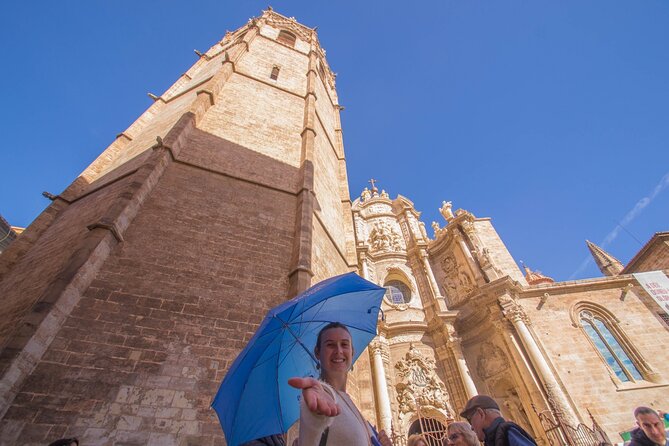
La Lonja de la Seda is one of the most important stops for anyone interested in architecture or commerce. This Gothic building was completed in the 15th century in only about 15 years, an impressive pace for a major civil structure of its time.
The building was tied to the silk trade and the strength of Mediterranean commerce. Inside, the guide explains how the exchange worked and why silk mattered to Valencia. The site was declared a UNESCO World Heritage Site in 1996 because it is an exceptional example of civil Gothic architecture and a record of the power of trade in Mediterranean cities.
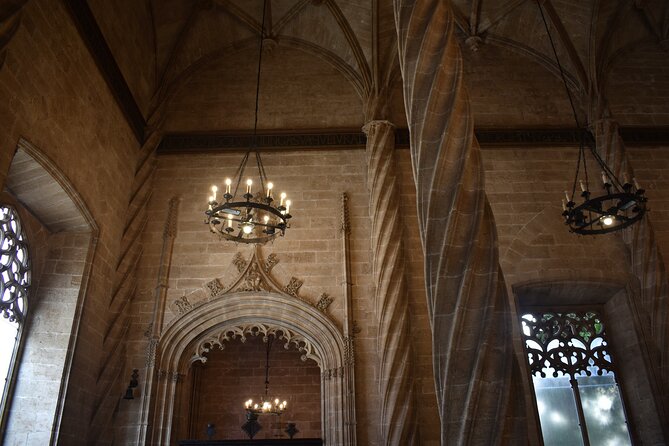
This is where the tour’s art and architecture promise is strongest. Large Gothic churches are familiar across Europe, but a grand Gothic building made for business and trade offers a different view of medieval life. I especially like that the visit is not limited to the famous exterior. You go inside, and the explanation includes the elaborate ceiling on the second floor.
La Lonja also provides a welcome change of mood after the churches. Instead of saints, frescoes, and relics, you are looking at contracts, merchants, money, and the built environment of trade. The contrast makes the route feel carefully chosen.
Admission is included, which improves the value of the $66.54 price. If you visited the three ticketed monuments separately, you would still need to pay for admission and arrange your own explanations. Here, the tickets and interpretation are combined into one compact visit.
More guided tours in Spain:
- Fast Track Sagrada Familia Guided Tour
★ 4.5 · 8,795 reviews - Barcelona: Sagrada Familia Skip-the-Line Guided Tour
★ 4.3 · 5,365 reviews - Barcelona: Sagrada Familia Priority Access Guided Tour
★ 4.9 · 4,917 reviews - Barcelona: Sagrada Familia Guided Tour with Tower Access
★ 4.3 · 4,729 reviews
Valencia Cathedral and the story of the Holy Chalice
The Cathedral is the longest and most layered stop on the route. Construction began in the 13th century on the site of an old Roman temple that later became a mosque. The building has been altered over the centuries, so you can see Romanesque, Gothic, Renaissance, and Baroque elements in one complex.
The guide points out the Holy Chalice, a relic traditionally associated with the Last Supper. The Cathedral’s claim is a major part of Valencia’s cultural identity, and the tour presents the story alongside the building’s art and history. Popes John Paul II and Benedict XVI used the relic during Eucharistic celebrations on visits to Valencia, a detail that helps explain its continued importance.
The Cathedral also contains major Renaissance paintings. One especially interesting detail is the rediscovery of Renaissance frescoes on the high altar after a later Baroque covering was removed. The result is another visible example of how Valencia’s monuments changed over time rather than remaining fixed in one period.
You should expect the Cathedral visit to be informative rather than rushed. Guides have been praised for explaining the Holy Grail story, the Roman past, and the building’s artistic changes in a way that ties them together. If you are particularly interested in painting or architectural detail, this may be the section where you want to ask extra questions.
One practical point: the Cathedral area can be confusing if the group separates. The tour provider has acknowledged a past misunderstanding in which participants waited outside while the guide and group were elsewhere nearby. I would stay close, listen carefully to instructions, and confirm the meeting spot before stepping away for photographs.
Finishing in Plaça de la Verge
The walk finishes at Plaça de la Verge, one of the most useful places in central Valencia for understanding the relationship between the city’s religious monuments. The square brings the Cathedral and Basilica together in one view, making it a natural final stop.
The guide uses the plaza to review the main cultural points of the morning or afternoon. You may leave with a better sense of how the Cathedral, San Nicolás, the old walls, and the merchant district fit together.
The square is also a practical place to continue exploring on your own. Since the experience ends where the meeting information places the start, you are already in the center of the old town. Still, pay attention to the precise instructions you receive. The itinerary begins with Torres dels Serrans, while the stated start and end point is Plaça de la Verge. That may simply reflect the route arrangement, but it is worth clarifying before the tour begins.
How the three-hour pace feels
The advertised duration is about three hours, and the route covers roughly 2 to 3 miles. That makes it a substantial walk, though the pace is generally described as comfortable rather than strenuous.
You will spend time standing in churches, the exchange, and public squares. Wear shoes you can walk in for several hours, and bring water, especially in hot weather. One guide was praised for keeping the group in the shade when possible and stopping so people could buy water. That sort of practical care matters in Valencia’s heat.
The route does not leave much spare time for photographs at every stop. One participant felt the tour could have used extra photo pauses. If you want careful architectural shots, you may need to take quick pictures while the guide is speaking or return to a favorite site afterward.
The group limit is 20 people, though some departures may be much smaller. A small group makes it easier to hear explanations and ask questions. It also helps in churches and narrow streets, where a large crowd can feel awkward.
English is the offered language. Most feedback praises the guides’ clarity, but one person found that a guide sometimes struggled with English. That is a fair consideration if you want highly technical architectural vocabulary. The experience is best suited to people who enjoy stories, context, and major sights, not to specialists seeking a formal art lecture.
Is $66.54 a fair price?
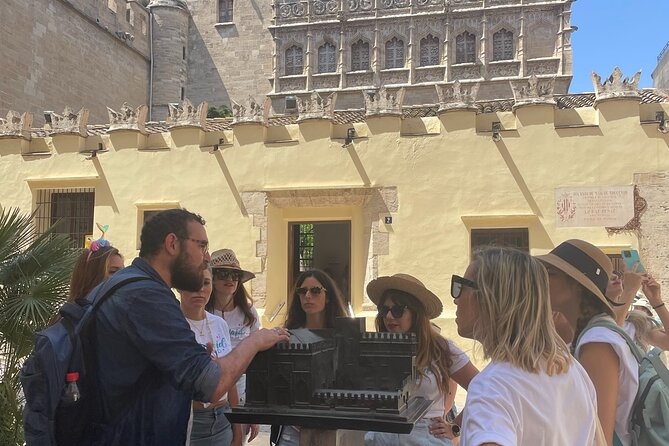
At $66.54 per person, this is not the cheapest way to walk around Valencia. I think the price makes sense if you value three included admission tickets, a professional art historian guide, and a tight route through the old center.
The ticket value matters most at San Nicolás, La Lonja, and the Cathedral. You also save the time of working out where to enter and how to connect the sites. The guide’s line management has been a repeated strength, with several people entering the monuments without long waits.
The cost is less attractive if you prefer to explore at your own speed, stop often for photographs, or spend an hour in each church. You may feel hurried if you want to read every caption or linger over every painting.
I would book it near the start of your Valencia visit. It gives you a useful overview, helps you identify places to revisit, and provides food and neighborhood suggestions from the guide. It also works well for a short stay, since one half-day visitor used the tour to cover major sights efficiently.
Who will enjoy this Valencia walk?
I recommend it for first-time visitors who want a clear introduction to the historic center without spending a full day on a formal museum tour. It also suits anyone who likes architecture but wants the buildings explained in plain language.
History-minded families can benefit from the mix of medieval gates, silk merchants, churches, relics, and city walls. Children must be accompanied by an adult, and most people can participate, but the 2 to 3 miles of walking may not suit someone who needs frequent seated breaks.
I also like it for couples and solo visitors who want a social tour without a huge group. Guides such as Benito, Monika, Uriel, Jorge, Paulino, Carmen, and Manuel have been praised for warmth, clear explanations, and the ability to answer side questions.
You should skip it if your main goal is a slow photography walk or a specialist lecture focused only on architectural technique. The route covers a lot, and its real subject is Valencia itself: art, faith, trade, politics, and the way those forces shaped the old city.
Should you book it?
Book this tour if you want to enter Valencia’s headline monuments, understand what you are seeing, and cover the old center in three organized hours. San Nicolás, La Lonja, and the Cathedral make a strong combination, and the included tickets help justify the price.
I would choose it early in your stay, then return later to the places that deserve more time. Just confirm the meeting instructions, stay with the group around the Cathedral, and expect a walking tour rather than a relaxed photo outing.
Free cancellation is available up to 24 hours before the start time. The tour can also be moved or refunded if poor weather or low enrollment causes cancellation.
FAQ
How long does the tour last?
The tour lasts approximately three hours.
What monuments are included?
Admission to San Nicolás Church, La Lonja de la Seda, and Valencia Cathedral is included.
Is the tour offered in English?
Yes. English is the offered language.
Where does the tour start and finish?
The stated meeting and ending point is Plaça de la Verge in Valencia’s Ciutat Vella. The first sightseeing stop is Torres dels Serrans, so confirm the exact meeting instructions before arrival.
How large is the group?
The tour has a maximum of 20 participants.
Can I cancel for a full refund?
Yes. You can cancel at least 24 hours before the experience start time for a full refund. Changes or cancellations made less than 24 hours ahead are not accepted for a refund.
Just added around Spain
- Gaudí and Modernist Art: Guided Tour in Palma de Mallorca★ 4.5 · 3 reviews
- Marques de Riscal and Ysios Rioja Wine Tour w/ Lunch from Bilbao★ 5.0 · 24 reviews
- Love in the Gothic Quarter Barcelona: Self-Guided Romantic Walk★ 4.5 · 9 reviews
- Walking tour of the Gothic Quarter of Barcelona + Cathedral★ 5.0 · 8 reviews
- Wine tasting with a view of the Sagrada Familia★ 4.5 · 13 reviews
- Roman & Gotic & Gaudi in Barcelona: private walking tour★ 4.5 · 2 reviews
- Visit to the Modernist houses of the Americans★ 5.0 · 2 reviews
- Barcelona Jewish & Gothic Tour★ 5.0 · 18 reviews
Tickets, compared.
Barcelona: Sagrada Familia Entry Ticket with Audio Guide
Read our review →
Barcelona: Sagrada Familia Skip-the-Line Entry Ticket & Tour
Read our review →
Florence: Cathedral & Brunelleschi’s Dome Ticket & Audio App
Read our review →
Barcelona: Park Güell and Gaudí House Museum Entry Ticket
Read our review →
Barcelona: Gaudi’s Casa Vicens Skip-the-Line Entrance Ticket
Read our review →
Chicago: Architecture River Cruise Skip-the-Ticket Line
Read our review →
Florence: Brunelleschi’s Dome Climb Entry Ticket & Duomo
Read our review →