
Review · BARCELONA
Gaudí and Modernism – Private Walking Tour
Barcelona’s Modernist buildings are easy to admire and surprisingly hard to understand. This private walk connects the dots, from the city’s expansion into the Eixample to the symbols, rivalries, politics, and family fortunes built into its grand façades. You finish at the Sagrada Família, looking at Gaudí’s unfinished masterpiece with a guide beside you.
I like the relaxed pace and the private format, which give you room to ask questions and stop for details. I also like Patrick’s broad approach: he links architecture with Barcelona’s social and political past instead of treating each building as a pretty façade. The main consideration is that the tour stays outside the major buildings, so you won’t enter the Sagrada Família or take a full interior tour of every house.
Key points
- A private 2.5-hour walk: Your group has the guide to itself, with time for questions and adjustments.
- Patrick brings context: He connects Gaudí and other Modernist architects with Barcelona’s political, social, and architectural changes.
- The route crosses the Eixample: Start at Plaça de Catalunya and follow Passeig de Gràcia toward the Sagrada Família.
- Look for hidden symbols: Casa Amatller and Casa Lleó i Morera reward close study of their façades.
- The Sagrada Família is an outdoor finale: You spend about 30 minutes examining its exterior and construction story.
- Best taken early in your visit: The background can sharpen your understanding of Gaudí’s buildings across Barcelona.
Why this walk helps you read Barcelona
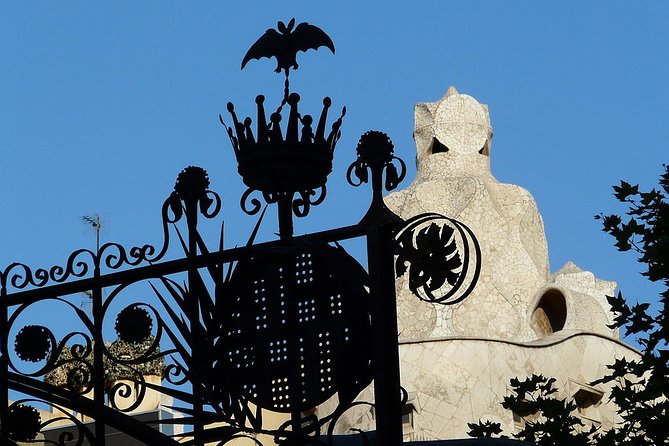
Barcelona’s Modernist architecture can feel like a contest in stone, tile, iron, and sculpture. Every façade seems to be calling for attention. A good guide helps you see that this was not only an artistic movement. It was also tied to the rise of wealthy Catalan families, the growth of the city, and the desire to show status in public.
That is the useful idea behind this tour. You begin at Plaça de Catalunya, where the old city meets the Eixample. The square is more than a convenient meeting point. It marks the shift from the dense medieval center to the broad, ordered streets created as Barcelona expanded.
From there, the walk gives you a working vocabulary for the city. You’ll hear about the growth of the Eixample, the bourgeois families who commissioned elaborate homes, and the marks left by the Spanish Civil War. These details help turn a simple stroll into a way of understanding why Barcelona looks the way it does.
The private setting matters here. You are not trying to hear a guide over a large group, and you can pause when a carved figure, lamp, balcony, or bit of masonry catches your eye. Patrick is also described as adapting his pace to the needs of older visitors, which makes this a sensible choice if you prefer a walk that does not feel rushed.
More Gaudí tours in Barcelona:
- Barcelona: Park Güell and Gaudí House Museum Entry Ticket
★ 4.5 · 6,326 reviews - Sagrada Familia & Gaudi Tour Private or Small Group with Tickets
★ 4.5 · 1,188 reviews - Complete Gaudi Tour: Casa Batllo, Park Guell & Sagrada Familia
★ 5.0 · 1,152 reviews
Plaça de Catalunya and the city’s turning point
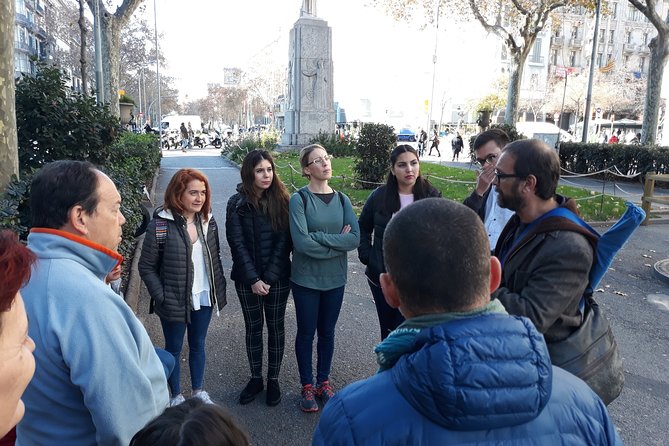
The opening stop lasts about 10 minutes. That may sound brief, but Plaça de Catalunya is used well as an orientation point rather than as a long sightseeing stop.
The guide explains how Barcelona changed as it expanded beyond the old city. The Eixample’s broad avenues and blocks were part of that transformation. Standing at the edge between the older center and the newer district gives you a clear sense of the city’s two different characters.
This is also where the tour brings in the Spanish Civil War. You’ll hear how conflict left marks that can still be seen around the city. The subject adds weight to the architecture, reminding you that these elegant streets have not existed in a calm museum setting.
I like beginning here because it prevents the rest of the walk from becoming a parade of famous façades. You start with the city itself, then move into the buildings and people who shaped the Eixample.
Passeig de Gràcia, Barcelona’s grand public stage
Passeig de Gràcia is the route’s main architectural corridor. The stop lasts about 15 minutes, though you’ll continue along this grand avenue as the walk develops.
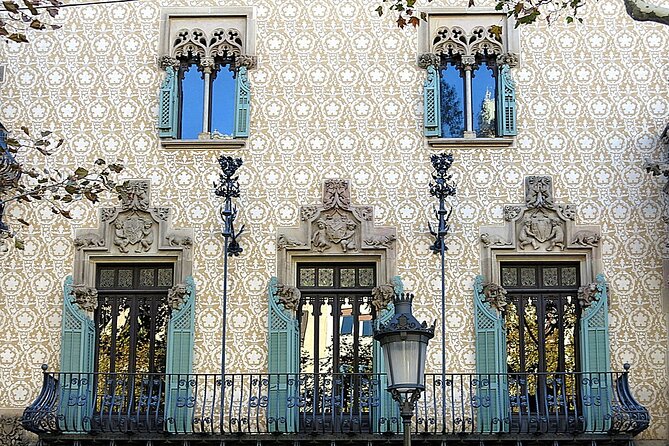
In the late 19th and early 20th centuries, this was the showcase street of Barcelona’s prosperous Catalan families. Their homes were not modest private spaces. They were public statements, designed to show taste, money, ambition, and social position.
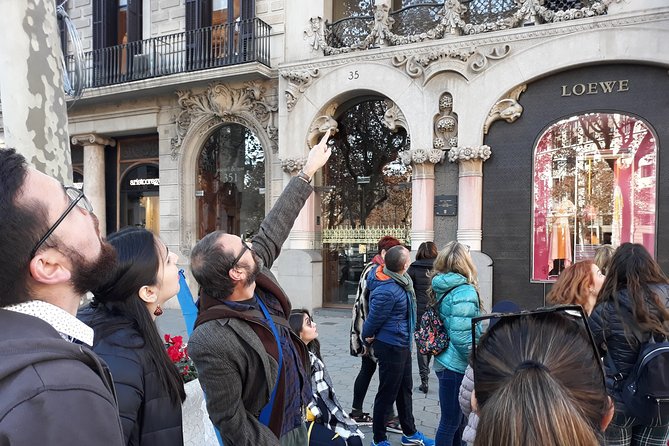
Look upward as you walk. The details are easy to miss if you focus only on street level. Balconies, windows, rooflines, stonework, and decorative forms compete for your attention. The guide’s job is to tell you where to look and why the details matter.
The broad avenue is also practical for the tour. It links several important Modernist buildings in a compact area, so you get a strong introduction without spending the whole afternoon crossing the city. Still, you should expect an urban walk with traffic and city noise. This is not a quiet garden stroll.
Bancs Fanals and the details at street level
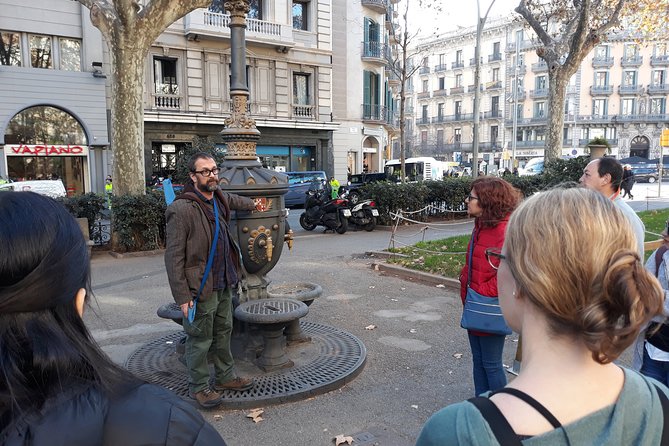
The Bancs Fanals are Modernist street lamps along Passeig de Gràcia. You spend about 10 minutes examining them, and that small stop is one of the route’s pleasant surprises.
Barcelona’s famous architecture is often associated with houses and churches, but the lamps show how the style reached into ordinary public fixtures. Their elaborate forms and symbols turn a practical object into part of the city’s visual program.
This is a good place to slow down. You can compare the lamps with the larger buildings around them and see how Modernist design worked at different scales. The point is not simply that the lamps are decorative. It is that Barcelona’s public spaces were designed to feel special, too.
For photographers, the stop offers close details rather than only grand views. You may find that the smaller elements give you better pictures than another distant façade.
More architecture walks in Barcelona:
- Barcelona: Old Town and Gothic Quarter Walking Tour
★ 4.8 · 1,393 reviews - Ramblas, Old Town, Gothic and Gaudi Architecture Walking Tour
★ 5.0 · 723 reviews - Kids and Family Gothic Quarter Walking Tour in Barcelona
★ 5.0 · 465 reviews - Barcelona Gothic Quarter Walking Tour
★ 4.5 · 456 reviews
Casa Lleó i Morera and the Manzana de la Discordia
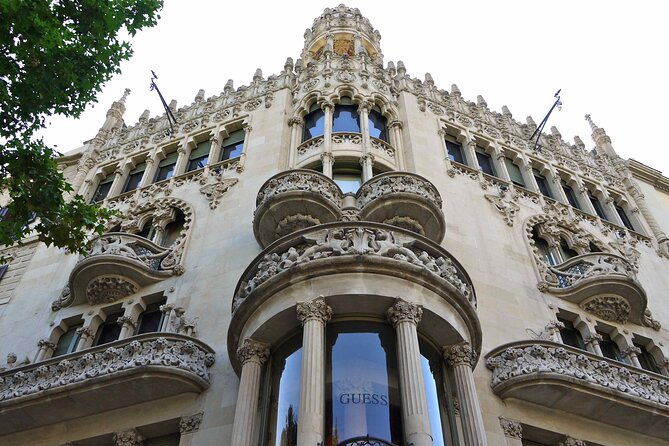
Casa Lleó i Morera is part of the famous Manzana de la Discordia, often translated as the Block of Discord. The block gathers several major Modernist houses close together, creating one of Passeig de Gràcia’s best architectural comparisons.
The building was designed by Domènech i Montaner at the beginning of the 20th century. The tour focuses on the façade and on the ideas connected with both architect and owner. Instead of treating the house as a single style label, Patrick explains how its details point toward the life and thinking of the people behind it.
That approach is useful because Modernist buildings can blur together after a few hours. Casa Lleó i Morera has its own character, and a guide can help you separate it from the neighboring houses.
You should not expect a full interior visit here based on the stated route. The value comes from learning how to examine the outside closely and from placing the house within the rivalry and display culture of the block.
Casa Amatller and symbols carved into the façade
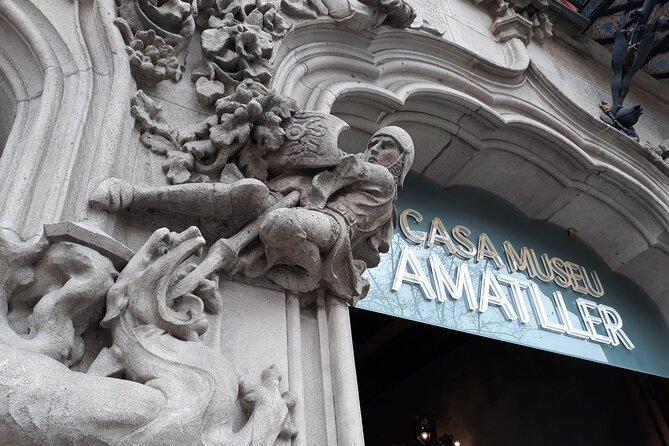
Casa Amatller is another major house in the Eixample, designed by Puig i Cadafalch for the Amatller family, who made their fortune as chocolate producers.
The chocolate connection gives the stop a human angle. You are not only looking at architecture created by a famous name. You are also hearing about a business family, the chocolate trade of the period, and the way commercial success could shape a private home.
The façade is the star. You’ll be encouraged to search for symbols and details rather than glance at the building and move on. The roofline, sculptural work, and unusual shapes make it one of the most distinctive houses on the route.
There is also the possibility of entering the inner courtyard for free, where you can see the staircase, old elevator, and refined sculpture. The information does not promise that every tour includes a full interior visit, so treat this as an available extra rather than the central feature of the walk.
I especially like the stop because it teaches you how to look. You begin to ask what a symbol means, why a figure appears in a certain place, and how the owner’s work or beliefs may have influenced the design.
Casa Malagrida and the story of a tobacco fortune
Casa Malagrida is the first example of a Modernist bourgeois house on the route. Its owner, Señor Malagrida, was a wealthy tobacco industrialist whose life connected Argentina and Spain.
The façade becomes a biography in stone. The guide uses its decoration to explain Malagrida’s life between the two countries and the money behind the house. That is a useful reminder that Barcelona’s Modernist buildings were financed by real business fortunes, not created in isolation by artists.
This stop also broadens the tour beyond the most famous names. Gaudí receives the biggest share of attention in Barcelona, but other architects, owners, and industries helped shape the city’s appearance. Casa Malagrida gives you one more example of how personal ambition found a public form.
Depending on the exact walking order, you may encounter this building as part of the route toward the final stop. The supplied timing does not assign a separate visit length, so expect a focused exterior explanation rather than a long standalone stop.
Sagrada Família, an exterior study with a grand finish
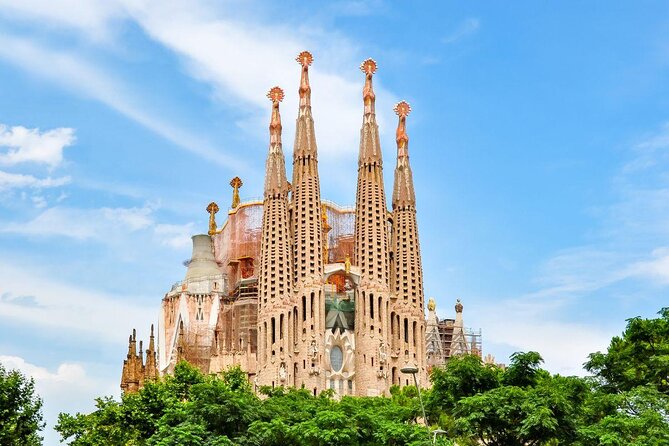
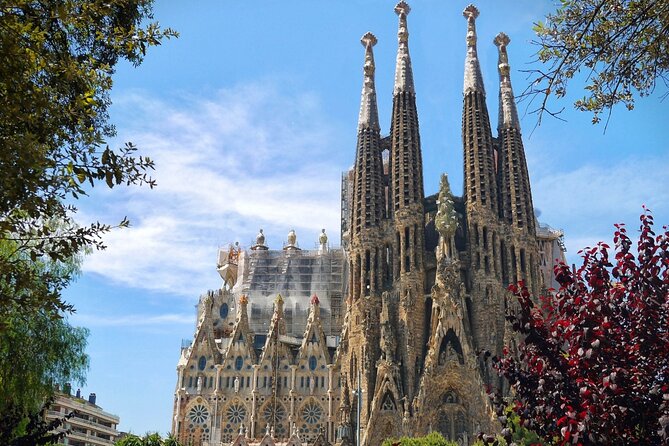
The tour ends in front of the Sagrada Família, where the final 30 minutes are devoted to its façades, history, secrets, and construction.
This is an effective ending because the basilica gathers many of the themes introduced earlier: individual vision, religious symbolism, technical ambition, public identity, and the long relationship between Barcelona and Modernism. By this point, you have already practiced looking for clues in façades, so the Sagrada Família becomes easier to read.
You’ll study its different exterior sides and hear how the building’s story developed over time. Gaudí’s work is still incomplete, which adds a special tension to the visit. You are looking at a monument that is both historic and still in progress.
The important limitation is clear: this tour finishes outside. It does not include admission to the basilica or an interior visit. If you want to see the interior, you’ll need a separate ticket and additional time.
That limitation can actually make sense for a first architectural orientation. You get a focused explanation of the exterior without using the whole walking tour for entry procedures and indoor sightseeing. But if your main goal is to go inside the Sagrada Família, budget for a separate visit.
What the $66.08 price means
At $66.08 per person, the tour is not priced like a basic group walk. You are paying for a private activity, English guiding, and the ability to keep the discussion centered on your own group.
The value improves when several people share the booking. A private group can ask more questions, adjust the pace, and spend longer on Casa Amatller or the Sagrada Família if those are your priorities. Group discounts are also offered, though the exact reduction is not stated.
For one person or a very small group, the price may feel high for a 2.5-hour walk, especially since the main buildings are viewed from outside. For a family, a couple, or friends who want a tailored introduction, it can be a fair price for the context and convenience.
I would compare it with the cost of separate guides, taxis between districts, and time spent trying to decode the buildings alone. You are not just paying for movement from one address to another. You are paying for the connections between architecture, money, politics, and city growth.
Timing, meeting point, and walking comfort
The meeting point is at the Apple store on Passeig de Gràcia, 1, near Plaça de Catalunya. The tour ends in front of the Sagrada Família, so the route carries you from the center of the Eixample toward one of Barcelona’s most famous monuments.
That one-way finish is handy. You do not need to return to the starting point, and you can continue with a separate Sagrada Família visit afterward if you have arranged one.
The activity lasts about 2 hours and 30 minutes. Most people can participate, and public transportation is nearby. Pickup is offered, though the published meeting point remains the clearest plan, so confirm the pickup details when booking if that option matters to you.
The walk requires good weather. You can cancel for a full refund up to 24 hours before the start time. Cancellations or changes made inside that window are not accepted, and a weather cancellation offers either another date or a full refund.
Who should book this private Barcelona walk?
I would choose this tour early in a Barcelona stay, especially if Gaudí’s work is one of your main reasons for coming. The guide’s explanation of style, symbols, and social setting can improve the way you see Casa Batlló, Casa Milà, and other Modernist buildings later.
It suits couples, families, friends, and older people who prefer a flexible pace. Patrick has adapted the walk for two seniors, and his style is described as personable, historically broad, and open to discussion.
It is less suitable if you want extensive interior access. The route is built around exterior architecture, with only a possible free look into Casa Amatller’s courtyard and no stated entry to the Sagrada Família.
It may also be too much history for someone who only wants quick photographs. The political and social context is part of the point. If that sounds appealing, the extra explanation will make the buildings more memorable.
Should you book it?
Book this walk if you want Barcelona’s Modernist architecture explained rather than simply photographed. The strongest features are the private format, Patrick’s ability to connect architecture with city life, the relaxed pace, and the close attention to symbols on Casa Amatller and Casa Lleó i Morera.
Think twice if you mainly want to enter the Sagrada Família or tour several interiors. In that case, pair this walk with separate admission and allow extra time at the basilica.
For most visitors, the smartest plan is to take it near the start of your Barcelona visit. You’ll finish with a better eye for façades, public design, family symbols, and Gaudí’s grand ideas. At $66.08 per person, it offers the best value when shared by a private group that wants conversation, not just a route.
FAQ
How long does the Gaudí and Modernism private walking tour last?
The tour lasts approximately 2 hours and 30 minutes.
Where does the tour begin?
It begins at the Apple store on Passeig de Gràcia, 1, in the Eixample area near Plaça de Catalunya.
Where does the tour end?
The walk ends in front of the Sagrada Família in Barcelona’s Eixample district.
Is the Sagrada Família included inside the tour?
No. The tour examines the Sagrada Família from the outside and spends about 30 minutes discussing its façades, history, secrets, and construction.
Is this a private tour?
Yes. Only your group participates in the activity.
What language is offered?
The tour is offered in English.
Can I cancel the tour for a refund?
Yes. You can cancel up to 24 hours before the start time for a full refund. If poor weather causes the tour to be canceled, you’ll be offered a different date or a full refund.
Just added around Barcelona
- Love in the Gothic Quarter Barcelona: Self-Guided Romantic Walk★ 4.5 · 9 reviews
- Walking tour of the Gothic Quarter of Barcelona + Cathedral★ 5.0 · 8 reviews
- Wine tasting with a view of the Sagrada Familia★ 4.5 · 13 reviews
- Visit to the Modernist houses of the Americans★ 5.0 · 2 reviews
- Barcelona Jewish & Gothic Tour★ 5.0 · 18 reviews
- Roman & Gotic & Gaudi in Barcelona: private walking tour★ 4.5 · 2 reviews
- Barcelona Gaudi Tour: Sagrada Familia, Casa Batllo & Casa Mila★ 5.0 · 4 reviews
- Self-Guided Audio Tour-The Surrealist Barcelona of Dalí and Gaudí★ 3.5 · 8 reviews
Gaudí Tours, compared.
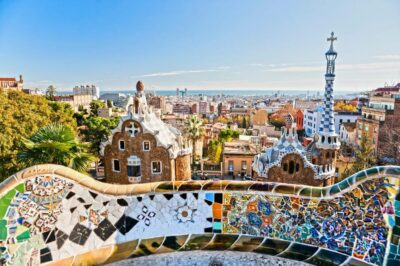
Barcelona: Park Güell and Gaudí House Museum Entry Ticket
Read our review →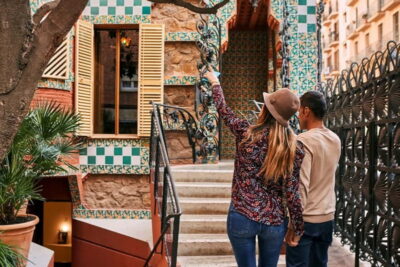
Barcelona: Gaudi’s Casa Vicens Skip-the-Line Entrance Ticket
Read our review →
Sagrada Familia & Gaudi Tour Private or Small Group with Tickets
Read our review →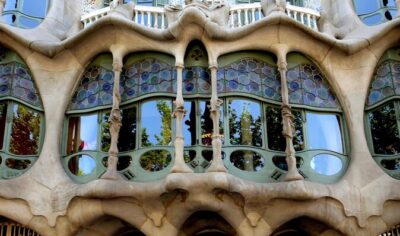
Complete Gaudi Tour: Casa Batllo, Park Guell & Sagrada Familia
Read our review →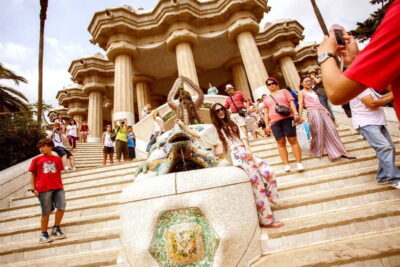
Park Güell: Guided Tour with Optional Gaudí Experience Entry
Read our review →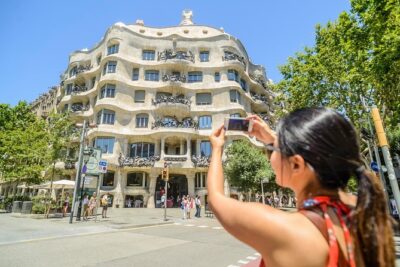
Barcelona e-Bike Tour: Gaudí & Old Town Small Group
Read our review →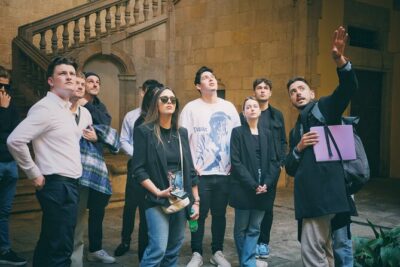
Ramblas, Old Town, Gothic and Gaudi Architecture Walking Tour
Read our review →
Gaudi´s Casa Vicens Skip the Line Ticket with Audioguide
Read our review →Browse the lists this tour appears in